 |
|||||
Prints, Engravings, Carvings and Lithographs |
|||||
 |
|||||
A Boer Prisoner’s little joke at Bermuda. Graphic. July 12th 1902. 22cms x 16. In order to ‘wind up’ the already jumpy British guards on the islands in the Great Sound some Boers put a full size dummy on a raft. When caught in the sentry ship’s searchlights it looked like an escaping prisoner. Bullets flew for quite some time. $100 |
|||||
|
A Cruise to the Somer’s Islands. Harper’s Weekly, March 21st 1857. 2 pages There four excellent views in this feature, but the writer can be patronizing and indeed offensive in his description of local Bermudian people. $120 |
||||
 View |
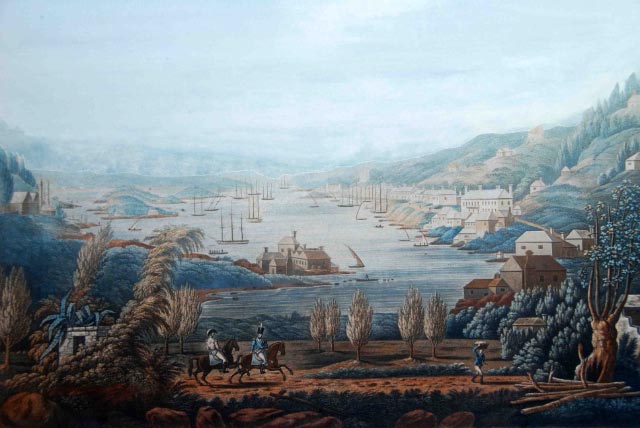
A View of the Town of Hamilton in the Bermudas or Summer Islands. Stadler, Joseph Constantine (British but perhaps of German extraction b.1780) Aquatint Engraving 16 x 20 1/2 inches. London. Published Jan 1st 1816 for the Proprietor Bermuda According to Jonathan Evans in his Encyclopedia of Bermuda Artists Stadler apparently produced his views from originals painted by Captain J Brown, an officer of the 100th Regiment (and Aide-de-Camp to the Lieutenant-Governor, Major-General Horsford). Brown was stationed in Bermuda c1812 - c1816. Stadler sold them as prints. One of the distributors was Thomas Driver. Very few of these have survived intact to the present day. |
||||
Bermuda - Ireland Island Fortifications. Full page in colour. Gleason’s 1854. This view of Casemates, which until recently was the main Bermuda prison, shows how carefully and impregnably the British built this Gibraltar of the West. They had no intention of it being overrun by any enemy from east or west. $100 |
|||||
|
Bermuda – Ireland Island Fortifications plus The Convict Dress at Bermuda. Illustrated London News. June 17th 1848. Hand coloured. At the time that this was sketched Casemates was the Barracks of the 42nd Highlanders. Also on this full page is a convict giving his name, his number and the prison hulk on which he was incarcerated. The convict population averaged 1600. No overseer was permitted to inflict more than five dozen lashes on him without the Governor’s permission. $100 |
||||
|
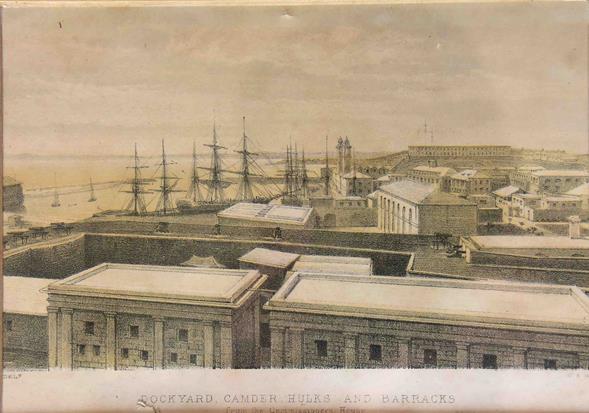
Bermuda Lithograph . Dockyard Camber Hulks and Barracks. c1857. 6 1/2 x 4 1/2 inches. Newly available Dec 2018
|
||||
|
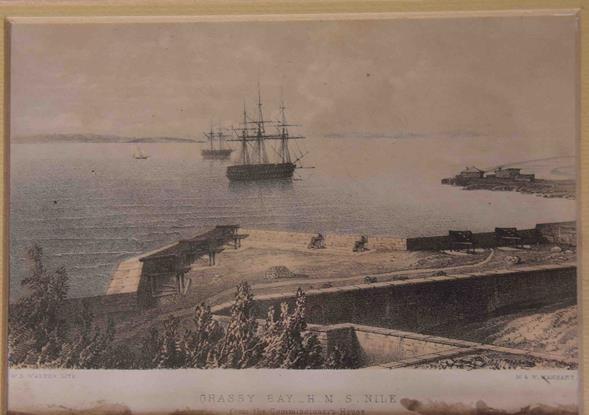
Bermuda Lithograph . HMS Nile in Grassy Bay. c1857. 6 1/2 x 4 1/2 inches. Newly available Dec 2018
|
||||
|
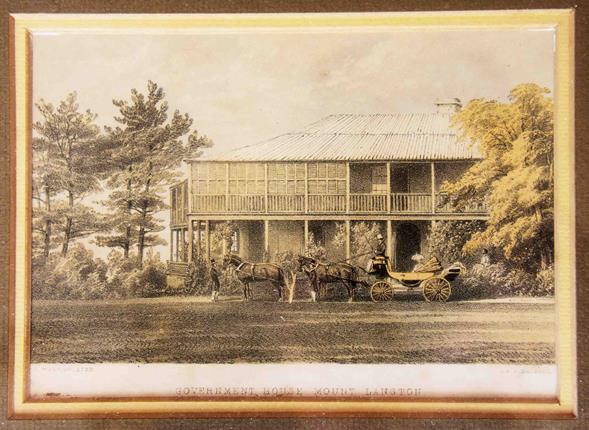
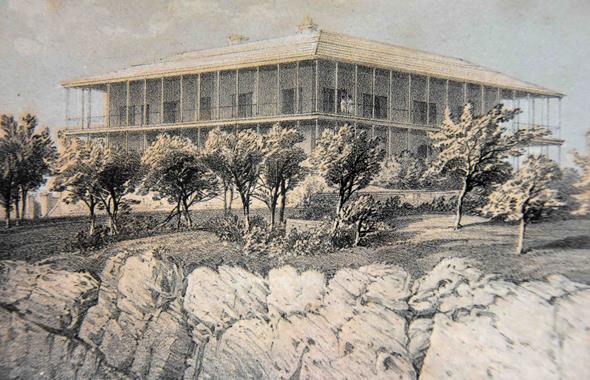
Bermuda Lithograph . Government House, Mount Langton. c1857. 6 1/2 x 4 1/2 inches. Newly available Dec 2018
|
||||
|
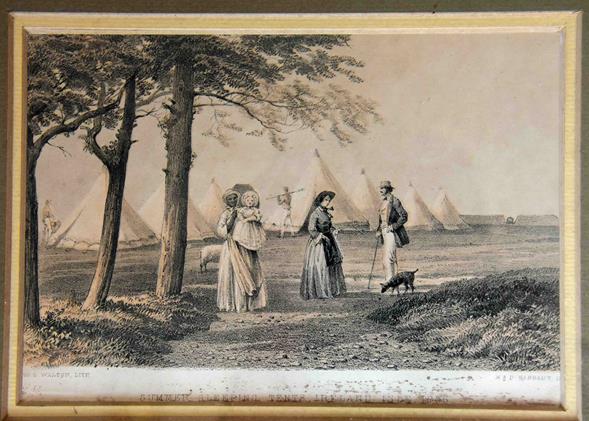
Bermuda Lithograph . Summer Sleeping Tents. Ireland Island. c1857. 6 1/2 x 4 1/2 inches. Newly available Dec 2018
|
||||
|
Bermuda Lithograph . The Commissioners House. c1857. 6 1/2 x 4 1/2 inches. Newly available Dec 2018
|
||||
|
Bermuda, The Winter Home of Princess Louise. I L N. Feb 17th 1883. Nothing put Bermuda on the map from a tourist point of view like the coming of this princess from Queen Victoria’s family on holiday from the cold climes of Canada. Her arrival was the subject of huge celebration and inspired the building of the Princess Hotel. Thus a second arm to the island’s financial well being was born in addition to the military presence. The full page shows six scenes of interest to the vacationer. $100 |
||||
|
Bermudas. Small fanciful sketch with vast mountain to the left of Dockyard c1860 The mountain seems to dwarf any other geographical feature on the island. It must have been exaggerated, though authorities regularly assert that the fine building stone on this edifice was cut down by the convicts over a fifty year period to make the arms of the Dockyard. A stone quarry certainly existed on a hill to the left of Cockburn’s Cut. Two of the convict hulks are at the right of the picture. $75 |
||||
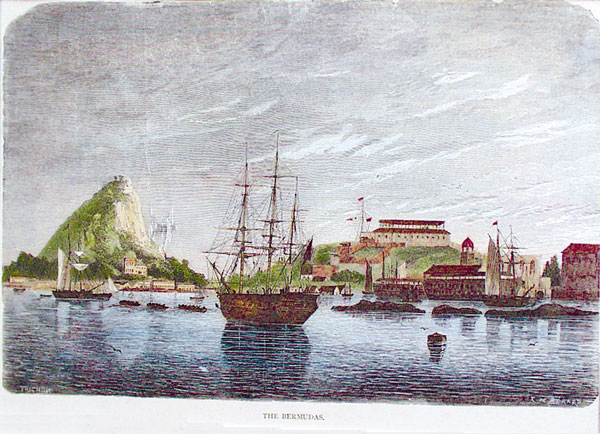
The Bermudas. A hand coloured French steel engraving. c1860. E de Berard. Framed. 40x32cms. $150. |
|||||
|
Boer Prisoners at Bermuda playing at Ping Pong Graphic May 24th 1902. The men seem quite relaxed as they are intent on their game on what appears to be Port’s Island. Two look to be recent arrivals since they have not yet grown their full beards. The Afrikaners vowed not to shave until they were released from detention. Full page. $120 |
||||
|
Boer Prisoners: The Bermuda Camps. I L N. Nov 23rd 1901 (3 full pages). Fifteen photographs including building Field Kitchens, Displaying Toys such as Bicycle, Model Threshing Machine and Elevator, Singing Classes, Hygiene, Tending the Sick and Wounded in Hospital and Sports Day on Darrell’s Island. These were to show that the British were not being inhuman in their treatment of POWs. $150 |
||||
|
Burning of U S Mail Steamer Roanoke off St Georges, Bermuda. Half page. I L N. Nov 26th 1864. Captured by ten Confederates secretly hiding among the Union crew, it was their intention to take the ship to Wilmington. However Bermuda would not let the mutineers land their prize, so all were transferred to a brig and the Roanoke allowed to burn about five miles off shore. She became yet another of the wrecks littering our seabed. $60. |
||||
|
Cast Iron Lighthouse for Great Isaac Rocks a hundred miles off Bermuda. I L N. Dec 29th 1855. Half page. Occasionally an engraving comes to light which mystifies the experts. Messrs Grissell, at the Regent’s Canal Iron works, were instructed by the Admiralty to build this 150 feet beacon. Where it was to be sited is still open to question. $100 |
||||
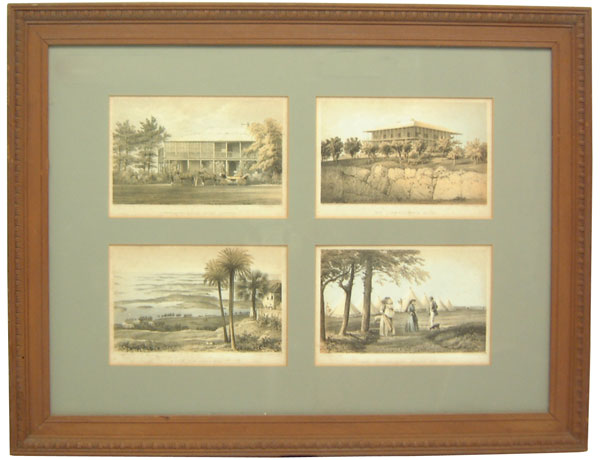
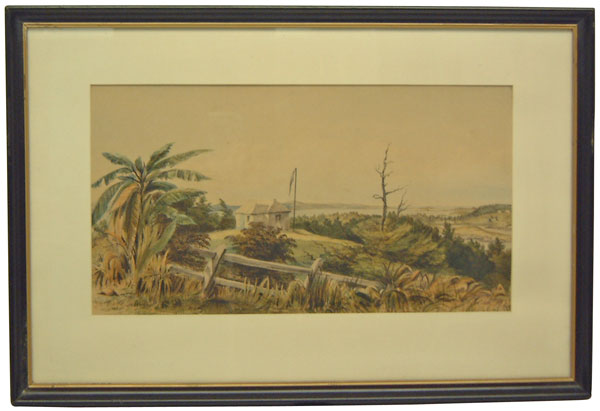
Four Views. from Col Ferdinand Whittingham, A Field Officer
(1814-1878). These handcoloured lithographs framed 50 x 35.5cm appeared
in his satirical account of Bermuda called Bermuda, A Colony, A Fortress
and a Prison or 18 months in the Somers Isles. It was published by Longmans
of London in 1857. |
|||||
|
From Bermuda to the Cape in a Transport Ship. Graphic July 16th 1881. Full page. A series of twelve line engravings showing the boredom of the long voyage through the tropics from here to South Africa, the most likely next posting after Bermuda. Depicted are the loneliness, the sadness of the girl friend left behind, the discomfort felt by the horses, the chores of the ship, the inevitable funeral at sea. (scarce). $120 |
||||
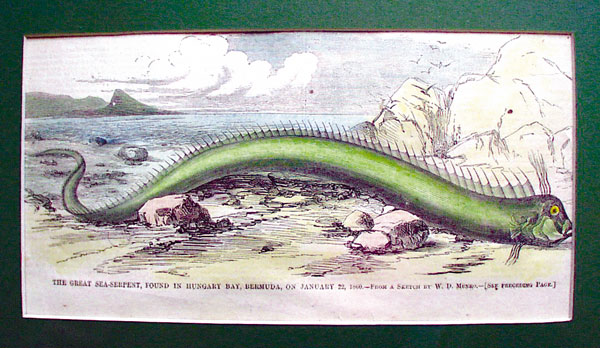
The Great Serpent Found at Hungary Bay on January22nd, 1860. 40x34cms Hand coloured, mounted and framed . $200. |
|||||
COMPLETE SET OF THIRTEEN VIEWS
FROM SKETCHES BY EDMUND HALLEWELL
Various individual original lithographs from incomplete sets of Hallewells, some matted and framed, others matted only. Two examples shown |
|||||
|
|||||
|
Harper’s Weekly. April 21st 1894. Whole Paper with an apparent Bermuda engraving of a Cargo of Bananas Being Auctioned. This may be what was intended but the rest of the article which appears two pages after the picture lauds the fact that Jamaica is a great supplier of bananas to New York. It would seem strange that no mention was made of Bermuda since that was the caption of the illustration. $100 |
||||
|
Ireland Island, Bermuda showing a panorama with prison hulks. Hand coloured. I L N. July 29th 1848. The view shows at least four of the floating prisons which housed the 1200 or so convicts mostly from England who built the Dockyard. The hulks had been Ships of the Line fighting at Trafalgar and elsewhere. Masts were taken off and extra decking and roofs erected to make places of incarceration. Conditions were probably pretty terrible. In their spare time the convicts carved pieces of limestone and bone into beautiful objects most of which ended overboard in the muddy silt at the bottom of the harbour. $100 |
||||
Ireland Island. A framed steel engraving of Casemates, the old naval barracks. From the Illustrated London News of 1848. 30x38cms. $90 - $130. |
|||||
|
Land of the Lily and the Rose. Large Advert for Hamilton Hotel. Harpers Weekly. 1891. Sold as an ideal winter resort with temperatures between 65 and 75 degrees Bermuda was touted as being free from the discomforts of the tropics such as malaria. The coral formation, we are told, acts as a safeguard against the accumulation of anything of an impure or offensive nature on its surface. The hotel was open for business from December to May. $75 |
||||
|
Military Life in Bermuda.Full page. Graphic. July 21st 1888. What the British soldier likes most in the second most isolated island in the world: Playing American Bowls, Drunken Hilarity, Socializing at the Royal Engineers Camp Fire, Dinghy Racing, Dancing with the American ladies at Prospect. $100 |
||||
|
Military Manoevres in Bermuda. Three quarter page. Graphic. July 19th 1873. The problem for the army battalions billeted on the island for the last half of the nineteenth century was that there was little for them to do. However their skills had to be kept honed for the next posting which was probably going to be much more dangerous. Here they are perfecting their ability at signaling and reconnaissance. $100 |
||||
|
Our First Footing in the Bermudas. Admiral Sir George Somers in 1609. I L N. Full page. June 13th 1903. The rubric beneath reads: ‘Somers, one of the chief promoters of the South Virgina Company sailed on June 2nd 1609, with a body of settlers. He was wrecked on the then little known islands called after Juan Bermudas, the Spanish seaman who first sighted them in 1515. Summers took possession of the islands in the name of James the First, and remained there ten months. He then proceeded to Virginia, but returned in November 1610 to the Bermudas where, on the ninth of the same month, he died “of a surfeit of eating of a pig”’. $110 |
||||
|
Our Friends, The Bermudians. Fanciful engraving of Front Street. c1860. The visitors who sketched the original drawing of this scene relished the fact that our island was not full of Italian or Spanish superstition as other places they had seen. No longer could they fear dirt or cholera. They felt safe under the British flag. $100 |
||||
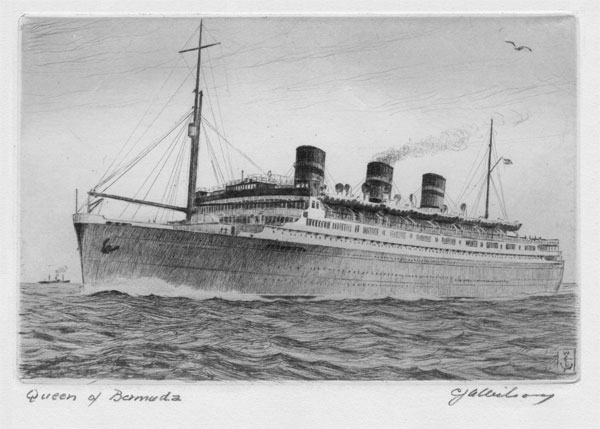
Queen of Bermuda. lithograph created by CJA Wilson (1880 - 1965). Attractive matted view showing the Furness Withy flagship under full steam. $1,250 |
|||||
|
Road View in Port Royal, Bermuda. Engraving c1890 A road cut by convicts shows that the prisoners were used for other purposes than building the elaborate stone works at the Dockyard. There were in 1890 one hundred and fifty miles of fine hard roads in Bermuda, sometimes hacked out of the solid rock and at all points of danger ‘carefully walled in by parapets of stone’. $60 |
||||
Sketches in Bermuda. Harper’s Weekly. Gibbs Hill, Tom Moore’s, Floating Dock And North Rock. Oct 11th 1873 In colour. Before the building of Gibbs Hill Lighthouse, Bermudian wreckers- black and white- had a field day luring unsuspecting vessels to their fate. The light’s construction cut this industry down from thirty to one in any given period. Because of its low lying geographical position the island was described by some Europeans as a Turkish bath. After a year or two many would break down not from illness but from sheer weakness and exhaustion. $100 |
|||||
|
Grounds, View of St Georges, Cedar Avenue. Harper’s Weekly. 1895. Full page. Soncy was the home of General Hastings, a retired American officer who did much to develop Fairylands, Pembroke as a desirable residential district in Bermuda. By the eighteen nineties the island was a hub of society, attracting the New York belle and the man of fashion. Dinners, dances, balls, theatricals, garden and tennis parties, reviews, sham-fights, regattas, annual sports and picnics were regular events. All you had to do was to cross the stormy Atlantic in the Winter Season to reach the place. $100 |
||||
|
St George’s Harbour from the Barracks, Gibb’s Hill and Front St, Hamilton. Graphic Aug 9th 1890 (full page). Such a notable regiment as the Grenadier Guards (see next entry) sent its 2nd Batt to Bermuda in this year, underlining how important the island had become in the eyes of the politicians. New Yorkers were visiting, lilies being exported in large quantities, Ireland Island a hive of activity. $100 |
||||
|
Watering Tanks at Tobacco Bay
St. Georges, Bermuda. Handsome handcoloured framed aquatint. Price on request. Fresh water was the sustaining force for battle scarred British warships in times of action in the Western Atlantic. Published on Feb 28th 1803 by J Gold, 103 Shoe Lane, London. Engraved by Mr Wells. The British flag bedecked fort to the left of Tobacco Bay proves that the military certainly did have an armed physical presence at that part of Bermuda's east end. |
||||
|
The Amusements of the Guards at Bermuda.Graphic. Nov 1st 1890. Half page. This engraving comes from a photograph taken by a Bermudian called Mr Richardson. In order to entertain the troops and to raise money for good causes the Leicestershire Regiment and the 2nd Batt. Grenadier Guards gave an entertainment in Happy Valley before 2000 spectators. Proceeds were in aid of the Soldiers’ and Sailors’ Home. $75 |
||||
| The Bermuda Floating Dock. Antique lithograph 15 x 24 1/2 inches. Price on request. Published May 20th 1869 by John B Day, 3 Savoy Street, Strand, London. Original colour. Entitled "The Bermuda Dock", Campbell's Patent Floating Dry Dock for H M Dockyard at Bermuda. Designed by Col. Clarke R E. Built at Messrs Campbell Johnstone and Co Works, Silvertown near North Woolwich and launched by Mrs Col. Clarke Sept 3rd 1868. The Drawing shows the 'Warrior' docked without the caissons.Designed for docking ships of the 'Bellephron' class when waterlogged between the caissons and capable of lifting without the caissons a vessel of 8,700 tons weight which with the weight of the dock itself 8,000 tons gives a total displacement of 16,700 tons.Size of dock overall 381 feet in length, breadth overall 123 feet, inside 83 feet. Depth 74 feet. G.Dutton lithographer Of note is the fact that the Floating Dock was considered one of the wonders of the Victorian age. People then may not have spoken frequently of Bermuda as an island, but this feat of engineering on our shores certainly caught their attention. The Dock never left Bermuda. Its remains, broken by a storm, still give protection to small boats anchored at Spanish Point, Pembroke. |
|||||
|
The Bermuda Floating Dock and Naval Squadron at Porto Santo. Half page. I L N. July 3rd 1869. Having been launched with great difficulty the unwieldy Floating Dock had be towed across three thousand miles of stormy Atlantic. This was accomplished with the aid of a team of nine towing vessels led by HMS Agincourt and was completed in about five weeks, the sailors being very lucky with the weather. On July 29th she dropped anchor at Grassy Bay off Ireland Island. $50 |
||||
|
The First Attempt to Launch The Bermuda Floating Dock. Three quarter page. I L N. Sept 12th 1868. Since Bermuda is made largely of porous rock, to build a stone basin to dry dock ships of war was considered difficult. A huge dry dock, the first of its kind, costing a quarter of a million pounds sterling was therefore constructed in England. It took nearly three years to build and weighed more than eight thousand tons. Launching it caused its engineers as much anxiety as the Great Eastern had earlier caused I B Brunel because it was so heavy. $85 |
||||
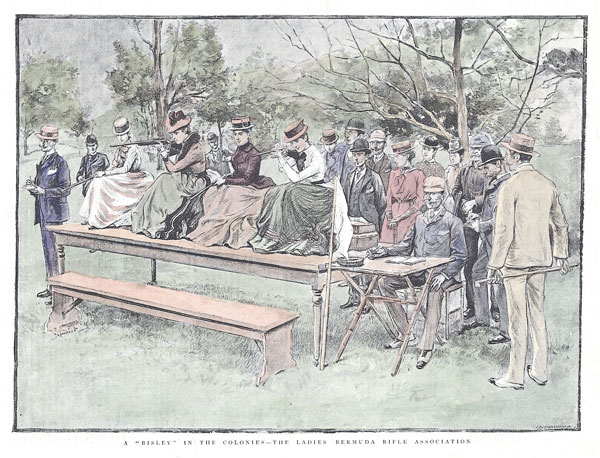
The Ladies Bermuda Rifle Association. Graphic. Full page. In colour. Aug 1st 1891. Another strange recreation in Bermuda during the last half of the nineteenth century. The setting appears to be the woods around Prospect Camp, and the four female contestants , all sitting cross legged, are aiming at rifle targets in a sport usually reserved for men in those days. Bisley in Surrey, England, has always been renowned as the centre of shooting for the British army. Of note is the seriousness of the whole scene and the primness of the moustachioed officals and the Easter hatted women. $120 |
|||||
|
The Welcome To The Princess Louise at Hamilton, Bermuda. Graphic. March 17th 1883 Half page. Princess Louise arrived from Charleston on board HMS Dido on January 29th. She was welcomed by the Governor Lieut General Gallwey and practically the whole of the island came out to meet her. Commentators remarked at how intermarried the local population were, with people of all sorts of hues and complexions. Initially Her Royal Highness stayed at Inglewood, the Paget property of prominent merchant Mr J H Trimingham. $80 |
||||
|
The Yellow Fever Camps at Bermuda in Tucker’s Town. Full page. I L N. Dec 28th 1867. The Artillery were tented at Castle Island and the Royal Engineers at Tucker’s Point which previously had contained just a small village. (Only Governor Daniel Tucker in the seventeenth century ever thought the area should be the site of a town). Communication between the billeted troops and the army at St Georges had to be by boat - much safer in times of deadly contagion. $100 |
||||
|
Trinity Church, Bermuda. The Cathedral with spire! I L N. March 28th 1885. The illustration shows the newly proposed replacement to the Trinity Church, built thirty years previously, which was destroyed by an incendiary supposed to be connected to the Fenian organization. The cathedral was to hold 1000 worshippers since the army and navy would go there as well as all the expected visitors following in the path of Princess Louise. The spire above the tower and the clock were eventually considered unnecessary. $60 |
||||
|
View From Spanish Point showing Fleet at Anchor. Full page. In colour. I L N. April 12th 1862. Spanish Point in Pembroke, the final resting place of the Dry Dock which had been built at great expense to careen the British Fleet on the Western Station. Between the Point and Dockyard is an expanse of water of varying depth where the ships, many veterans of the Battle of Trafalgar rode at anchor. Dockyard, which was still being built in 1862 was probably unable to berth them. There were convict hulks already in place on the wharves. $120 |
||||
|
View Of St George’s, Bermuda with prison hulks and View of Sugar Loaf, St George’s. Graphic. 1854. While Dockyard became the station of the British navy in Bermuda, St Georges had long been the principal barracks of the various military regiments. It was only from the 1880s that a presence in Hamilton was thought necessary, hence the construction of Fort Hamilton and the establishment of Prospect Camp on high ground in Devonshire. $150 |
||||
| Return to Home Page | |||||